
Ultra Processed Food. Food thats not food!
In this post we look at the foods we eat and their affect on our health positive or negative.
Our first article is the essence of the book by Dr. Chris van Tulleken entitled Ultra Processed People and deals with the growing health threat of ultra processed foods.
FOOD THAT’s NOT FOOD!
Consumption of Ultra Processed Foods: The Leading Cause of Early Deaths in Adults
An innocent looking packet of powdered soup. It is ultra processed food. Take a look at its ingredients below. All those ingredients with an E prefix are additives
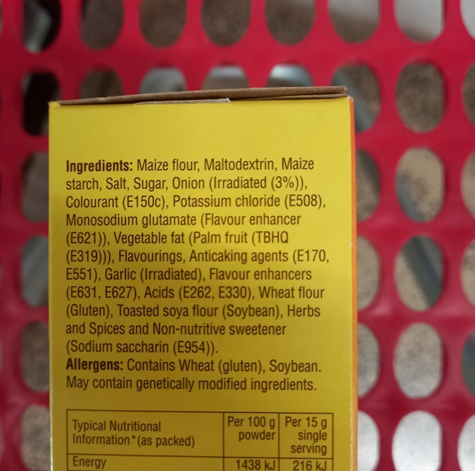
Who hasn’t noticed the alarming increase in the number of people living with obesity over the last twenty years? There has been at least a 20% increase in child obesity in that time. Have you also noticed that obesity tends to affect persons living with economic disadvantage more than those who don’t? Indeed, obesity is a disease of poverty.
Obesity sufferers are prone to a host of lifestyle diseases including but not limited to type 2 diabetes, strokes and heart disease and some cancers. Indeed, consumption of mainly ultra processed foods has taken over from cigarette smoking as the leading cause of early death in adults.
What explains this rapid increase in obesity levels? A number of schools of thought offer competing explanations: Lack of or insufficient exercise, lack of will power, excess energy ingestion (translation: eating too many carbs) or a combination of these. Bear in mind that it is possible to determine with some precision when levels of obesity commenced increasing. Thus, to cite will power or lack of exercise as the primary reason, one would need to prove that during that time the general populace and especially children suddenly ceased or reduced the previous rate of exercising and commenced overeating. This has been shown not to be the case, in addition, research has demonstrated that exercise alone does not result in weight loss without an associated reduction in calorie intake. The only exception to this are very high level exercise regimens which most people do not undertake.
There is ample evidence to show the current obesity pandemic commenced with the comprehensive growth in the consumption of ultra processed foods (UPF)
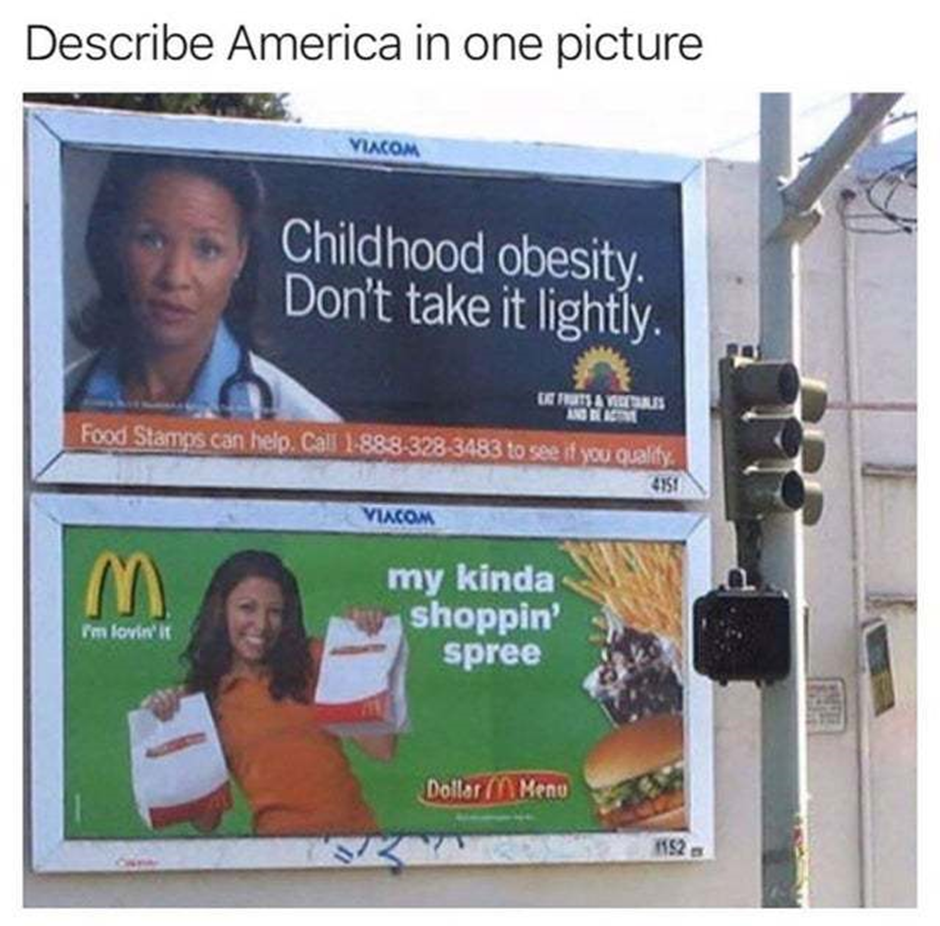
Not only in the USA. An unfortunate juxtaposition of billboards. However, it sends a clear message that there is a growing health threat of ultra processed foods. Society knows we have an obesity problem but seems unable to solve it in the face of unrelenting pressure to eat easily available ultra processed foods.
When we consider the growing health threat of ultra processed foods, we need to consider that our bodies are not evolved to process the new molecules used in ultra processed foods. Public health protection bodies such as the American FDA have tested individual additives and found, within the parameters used in analysis, that many additives do not appear to be harmful to human health. However, very few tests examine the impact of additives over the longer term and, moreover, there has been far less research into the effects of a combination of additives on human health.
What we have though is a plethora of formerly relatively rare conditions that can only have been caused by the rapid uptake of UP foods. There is no doubt that there has been and uptick in cardiovascular diseases, strokes and diabetes 2 – the so-called lifestyle diseases. This increasing frequency of diagnosis of these conditions appears to date from the significant introduction into the Western diet of UPFs in the 1990s. There is an even more precise case study available in the introduction of UPFs to Latin America in the early 2000s. Before 2010, the incidence of obesity and diabetes 2 was virtually unheard of. Since 2010 the rapid increase in such conditions is well documented
What Exactly are Ultra Processed Foods? (Hint: You probably would not be making these from scratch in your kitchen at home)
Ultra processed foods are complex to define but a rule of thumb may be that they contain ingredients that we don’t tend to use in the home and are only used by the food industry such as highly refined ingredients, preservatives, emulsifiers, flavourants and artificial colourants. They are added to foods for several reasons some of which of which are to increase shelf life, enhance flavour and appeal and to produce foods as cheaply as possible.
There is bound to be some confusion between ‘processed’ food and ‘ultra processed’ food. After all, aren’t most foods processed to some degree? Processed foods have been part of human culinary history for millennia and include everything we do to food as we prepare it. This includes smashing, grinding, cooking baking, smoking and all other food preparation methods. What it does not include is the adding of substances natural and or artificial that hitherto had no place in any kitchen. Compare the processes and ingredients used in the manufacture of butter versus those applied in the manufacture of margarine – arguably the very first UPF.
As a rule, UPFs are significantly cheaper than ‘real’ or non-ultra processed food. Take pizza, for example, you can purchase a pizza from the frozen food section of a supermarket for 5 to 10 times more cheaply than you can purchase it from a specialist pizzeria. Take a look at the list of ingredients on the frozen pizza packaging and observe the number of additives in the form of flavourants, preservatives, emulsifiers and colourants. These are cheaply manufactured, certainly much more cheaply than the fresh ingredients they are designed to imitate and, for any (traditional) food, there is a UPF equivalent.
Why do we eat ultra processed foods so quickly? (Hint: Because they are so yummy!)
UPFs are energy rich and nutrient poor. They are overwhelmingly soft and, with flavour enhancement, entice the consumer to eat this food rather rapidly. This last point is critical in any analysis of the riskiness of UPFs.
When we consume ordinary (or non UP foods) at a relatively slow or steady rate, after consumption of a certain quantity, our brains signal to us that we have become satiated. If, however, as most people would have experienced, we consume food rather quickly we can comfortably consume a lot more food before we become satiated. In other words, we get that sense of being ‘full’ somewhat later when we eat quickly than when we eat more slowly.
UPFs, generally, are hyper flavoured. They are sweeter than they would be if sweetened by sugar using artificial sweeteners (aspartame, saccharin) or `mimic an enhanced umami (meaty) flavour than natural flavours. All the components of the meal or snack have been finely disseminated and deconstructed and reconstructed using very fine particle sizes.
The result of this use of flavouring and texturisation is that the food is easily and rapidly consumed such that a far higher quantity is consumed than would have been the case had natural ingredients been eaten.
UPFs lack the nutrition that is found in natural ingredients. The stomach having been primed by the taste buds for a particular food would be expecting the actual (real) food components. When these do not arrive, it is not satisfied and continues to require ingestion of further food intake to be satisfied.
So, all in all, human intake of UPF will be faster and exceed in volume that of a non-ultra processed version of the same dish or meal. This excess calorie intake will lead, depending on the individual’s metabolism result in an increase in body mass and, often, obesity.
At this point it is important to note the addictive nature of many ultra processed foods. Think potato chips (crisps) and how virtually impossible it is to refrain from finishing a bag. UPF manufacturers have gone to great lengths to create flavour and texture in UPFs that are exceptionally difficult to resist. Many individuals have, in fact, become addicted to these foods. What Ultra Processed Foods do to us
Our bodies are not evolved to process the new molecules used in UP foods. Public health protection bodies such as the American FDA have tested individual additives and found, within the parameters used in analysis, that many additives do not appear to be harmful to human health. However, very few tests examine the impact of additives over the longer term and, moreover, there has been far less research into the effects of a combination of additives on human health.
The microbiome is a collective expression for the trillions of organisms-bacteria, fungi, viruses – in the gut. Such organisms assist in food digestion especially of fibres. Evidence is slowly mounting that emulsifiers used in UPFs can operate like a detergent in the stomach and purge it of these organisms. Emulsifiers include lecithin, carboxymethyl cellulose and polysorbate 80. It is believed that emulsifiers have the effect of causing the stomach to leak and for toxins to be carried to the organs and to damage these.
The message here is that additives in food don’t just cause obesity and harm those afflicted with obesity but can harm everyone who consumes UPFs as a large portion of their diet.

Manufacturers of Ultra Processed Food do not accept that their products are a public health hazard.
Manufactures of ultra processed foods will argue that they provide convenient, affordable healthy foods for the market particularly the lower end. However, as more evidence is collected regarding UPF ‘s deleterious effect on human health and that of our planet, we would like to believe that more pressure will be applied on UPF manufacturers to address the issues regarding their products.
One way to combat the growing health threat of ultra processed foods is to take a world class food supplement. May we suggest Neolife’s Pro Vitality. Read all about it here.